
Is Edmonton’s Industrial Land Policy Preventing Growth?
Policies designed to protect industrial land may instead be limiting adaptive reuse and restricting opportunities for local businesses.
Written by Megan Magill
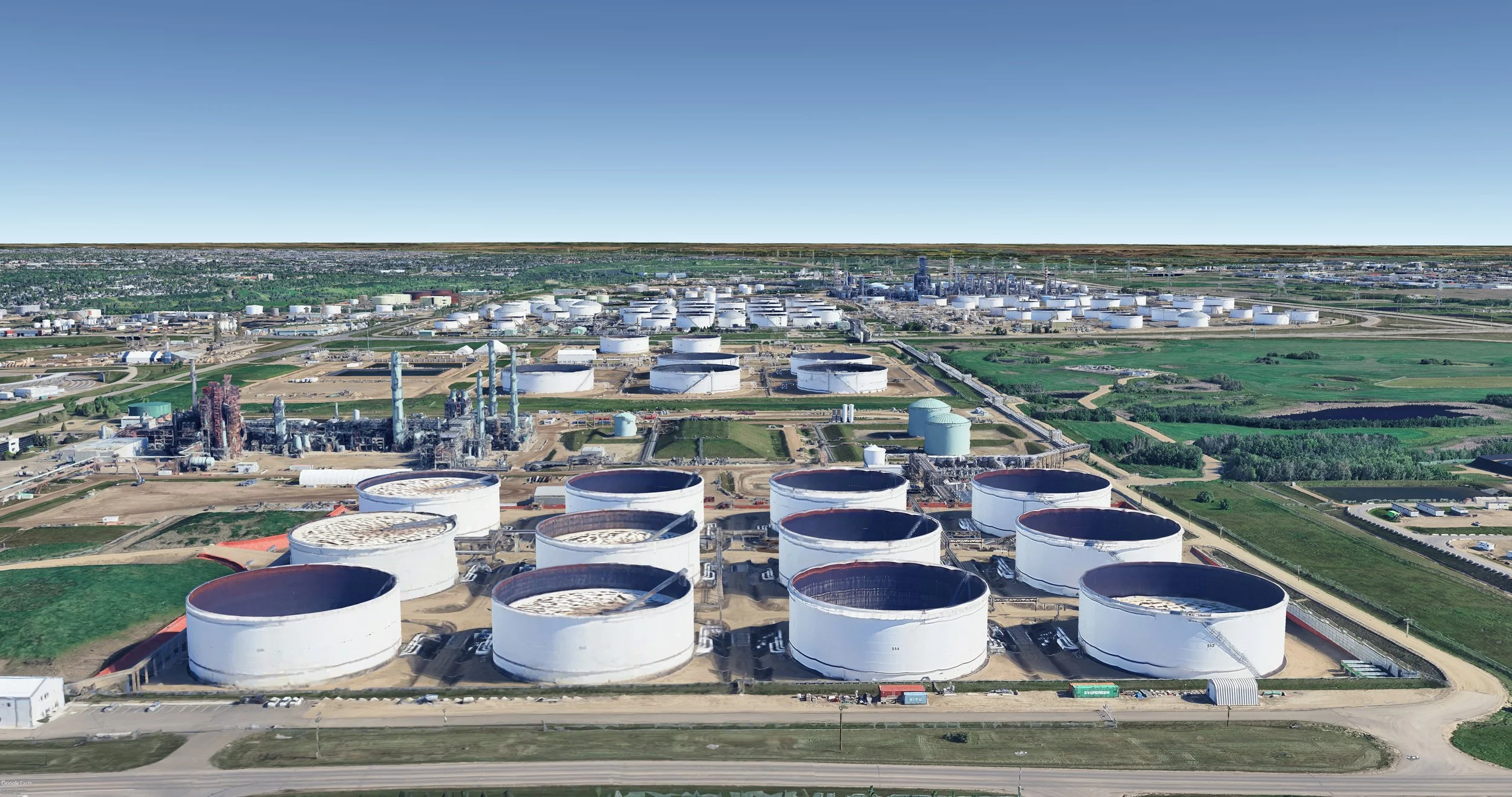
Industrial investors know which properties are right for their businesses—but does current City policy support those opportunities? Amidst a worrying lack of recent industrial investment in Edmonton, the City’s response has been to guard the limited inventory of pre-existing built-out industrial land. However, instead of drawing investors in, small businesses and community uses are being shut out.
Rising Industrial Taxes Are Driving Investment Elsewhere
Edmonton’s non-residential tax rate is now 230% the average rate of surrounding municipalities—a number that continues to grow. As a result, the City year over year loses out on industrial investment. To counteract this, the City has implemented a new version of the Industrial Investment Action Plan (IIAP) to make industrial development more appealing to developers and investors. The IIAP serves as the City's guide to industrial preservation and expansion across Edmonton. Its nine key actions focus on attracting investment and prioritizing the development of “shovel-ready” industrial land.
How Edmonton Regulates Industrial Land
The majority of industrial properties in Edmonton are zoned Business Employment (BE), Medium Industrial (IM), or Heavy Industrial (IH). The BE Zone permits light industrial uses and a broad range of commercial uses. It is a zone often found at the edges of industrial neighbourhoods, where it acts as a buffer between industrial activity and residential or commercial areas. IM and IH Zones are, by contrast, generally located in the interior of industrial areas and are meant to accommodate a variety of more intensive “traditional” industrial activities.
On January 1, 2024, the City shifted the regulatory landscape, replacing Zoning Bylaw 12800 with Zoning Bylaw 20001. Much of what the new Bylaw did was highly effective: it consolidated dozens of narrow, overlapping use definitions into broader categories, simplifying the system. For example, the Indoor Sales and Service use subsumed many similar uses from the previous Zoning Bylaw, including Markets, Convenience Retail Stores, and Warehouse Sales, reducing the need for rezonings. However, the Bylaw also removed or significantly impaired some uses that zones had previously allowed. In the IM and IH zones, several discretionary uses that were previously allowed have been cut out entirely. Custom Manufacturing, which encompasses many of the creative uses previously included in the IM zone, such as Breweries, Wineries, and Distilleries and Creation and Production Establishments, now limits Public Space areas to 150 square meters, severely inhibiting the implementation of these uses. While these zones kept their names and boundaries, the range of what can be done within them has narrowed.
In addition to the limitations presented by the new Zoning Bylaw, Edmonton's city-wide District Policy, which is directed by the IIAP, now restricts industrial land on a broader scale. Following the IIAP's initiative to preserve the limited existing stock of IM and IH land for future industrial development, the District Policy was updated in 2025 to discourage the conversion of IM and IH sites to lighter non-residential zones, subject to limited exceptions.² Together, these two policy changes changes compounded one another: uses were removed from IM and IH zones while policy pathways to lighter zones–where those uses remained permitted–were simultaneously closed off.
In theory, the IIAP changes are well-intentioned, as they were made to preserve the limited stock of industrial-zoned land for industrial investment. Whether this intention holds up in practice, however, is far less clear.
When Zoning No Longer Fits the Building
Consider a common scenario: a local, small-scale investor owns a two-storey industrial building zoned Medium Industrial. Constructed in the 1970s, it was designed for a mix of office, service, and light industrial uses rather than high-intensity industrial operations. As the City has narrowed the IM Zone to prioritize more traditional activity, a disconnect has emerged between the building's form and the uses the zone now allows for. The site is already fully developed, and too small for the large, flexible footprint that modern industrial operators desire, but because of its location in the interior of an industrial area, as opposed to the edge, it isn’t a candidate for rezoning. Now, the building falls between zoning categories, sitting underutilized with half its units vacant, with industrial investors continuing to look elsewhere for sites better aligned with their needs.
This scenario represents the current reality for many prospective light industrial or Business Employment type uses and the operators who rely on them. Consider pictures A, B, and C below: A and C accommodate outdoor storage operations and warehouse-type buildings, while the office bays in B employ no apparent industrial activities. And yet, all of these are zoned IM. They demonstrate the conflicting land uses that currently fall under IM and IH Zones.
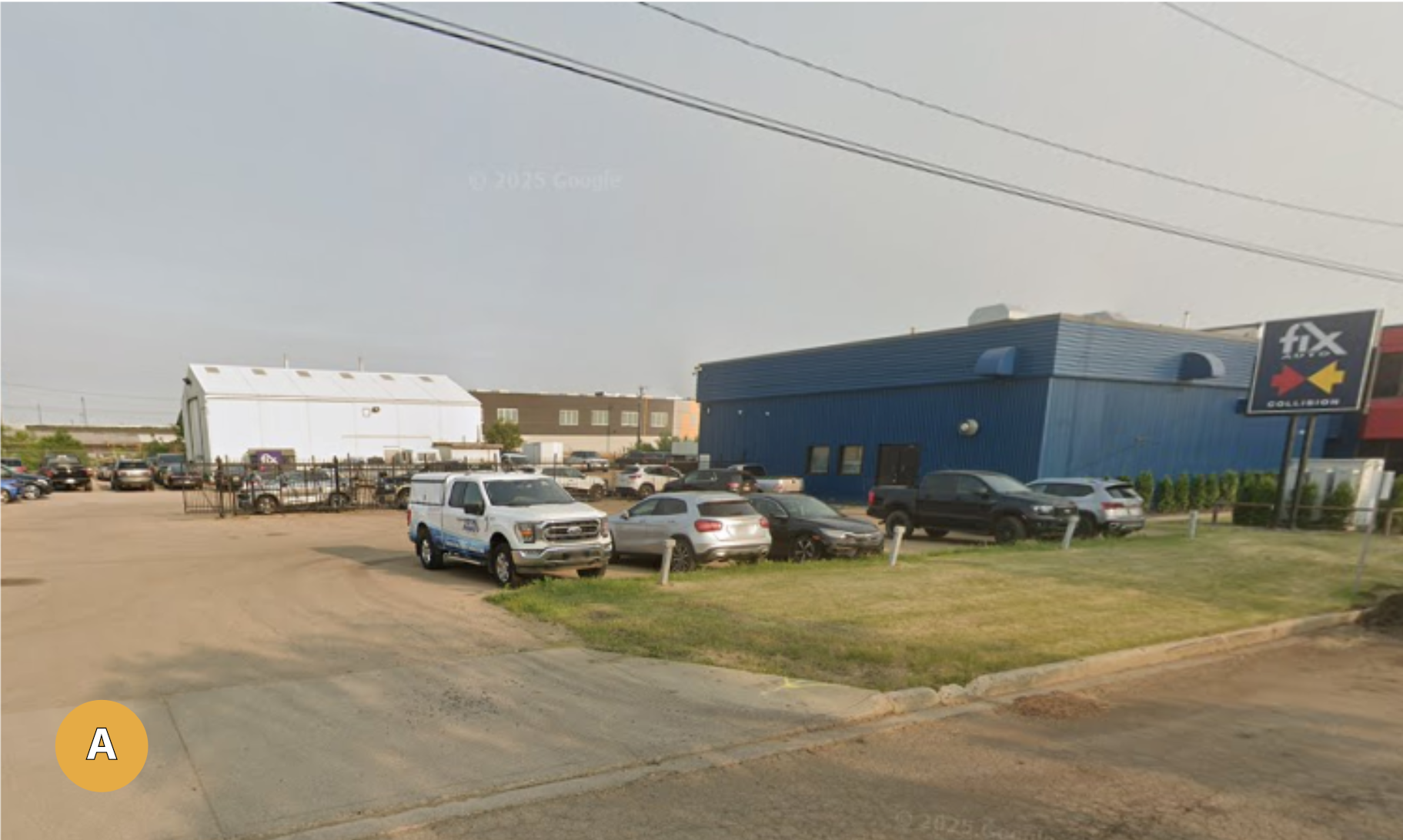
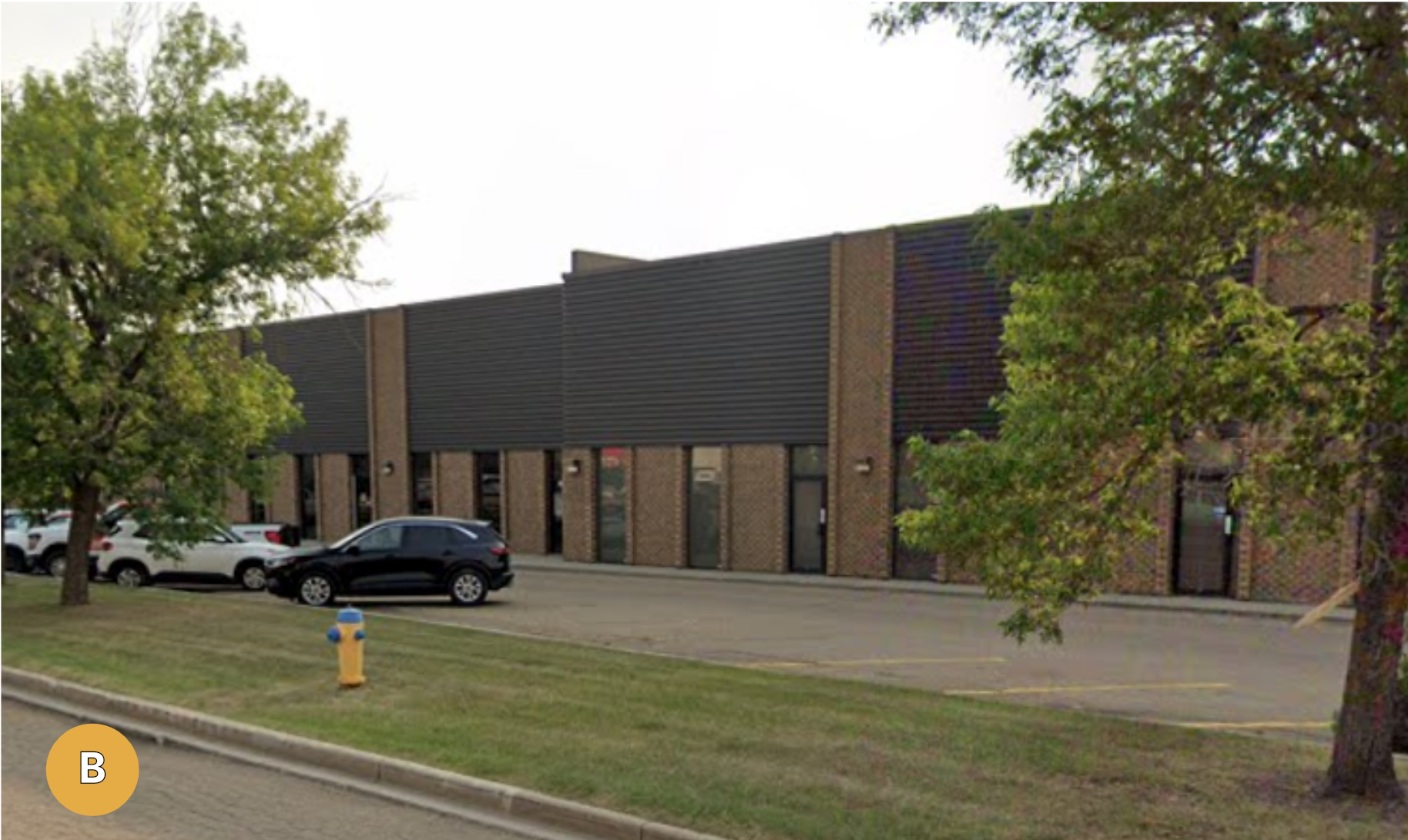
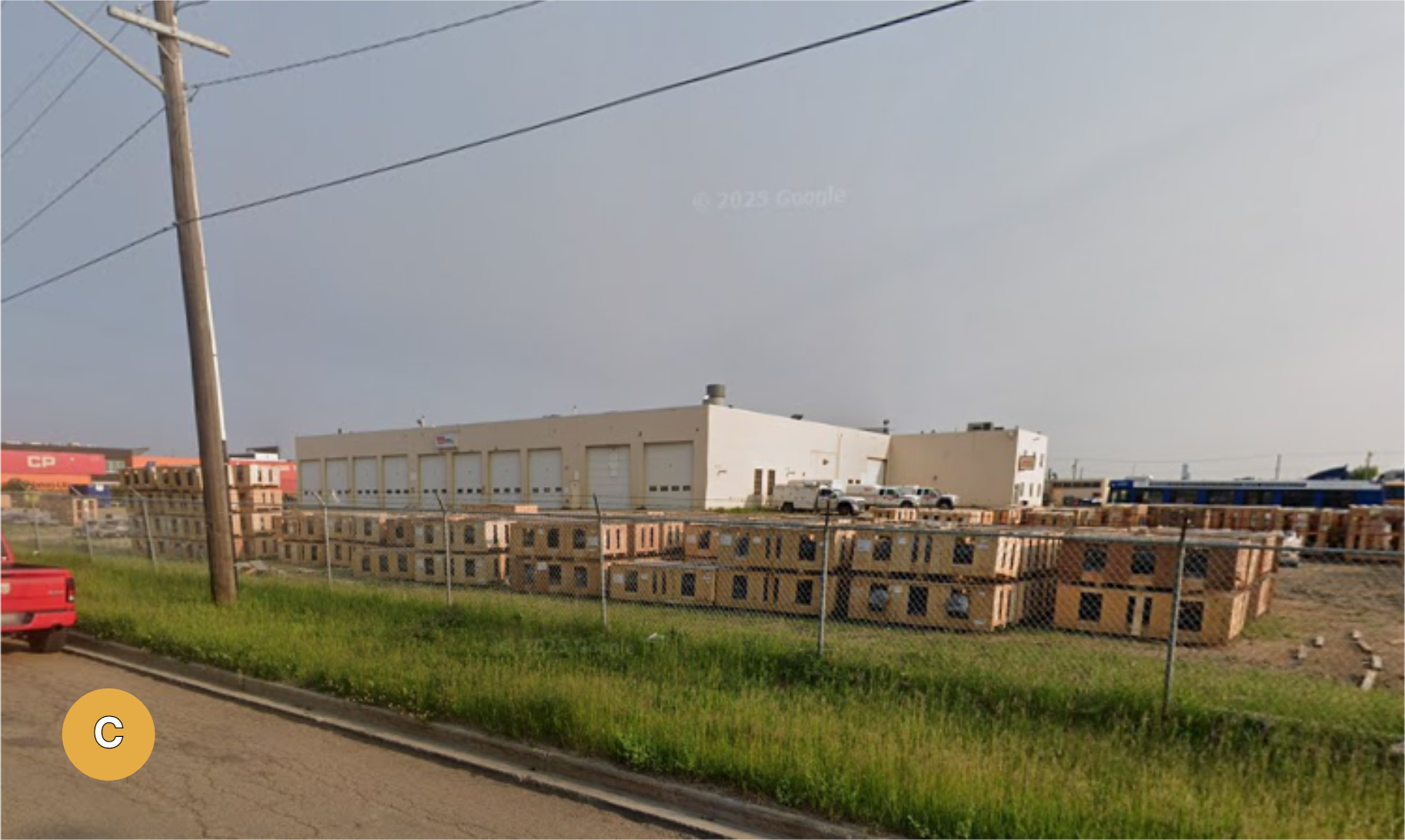
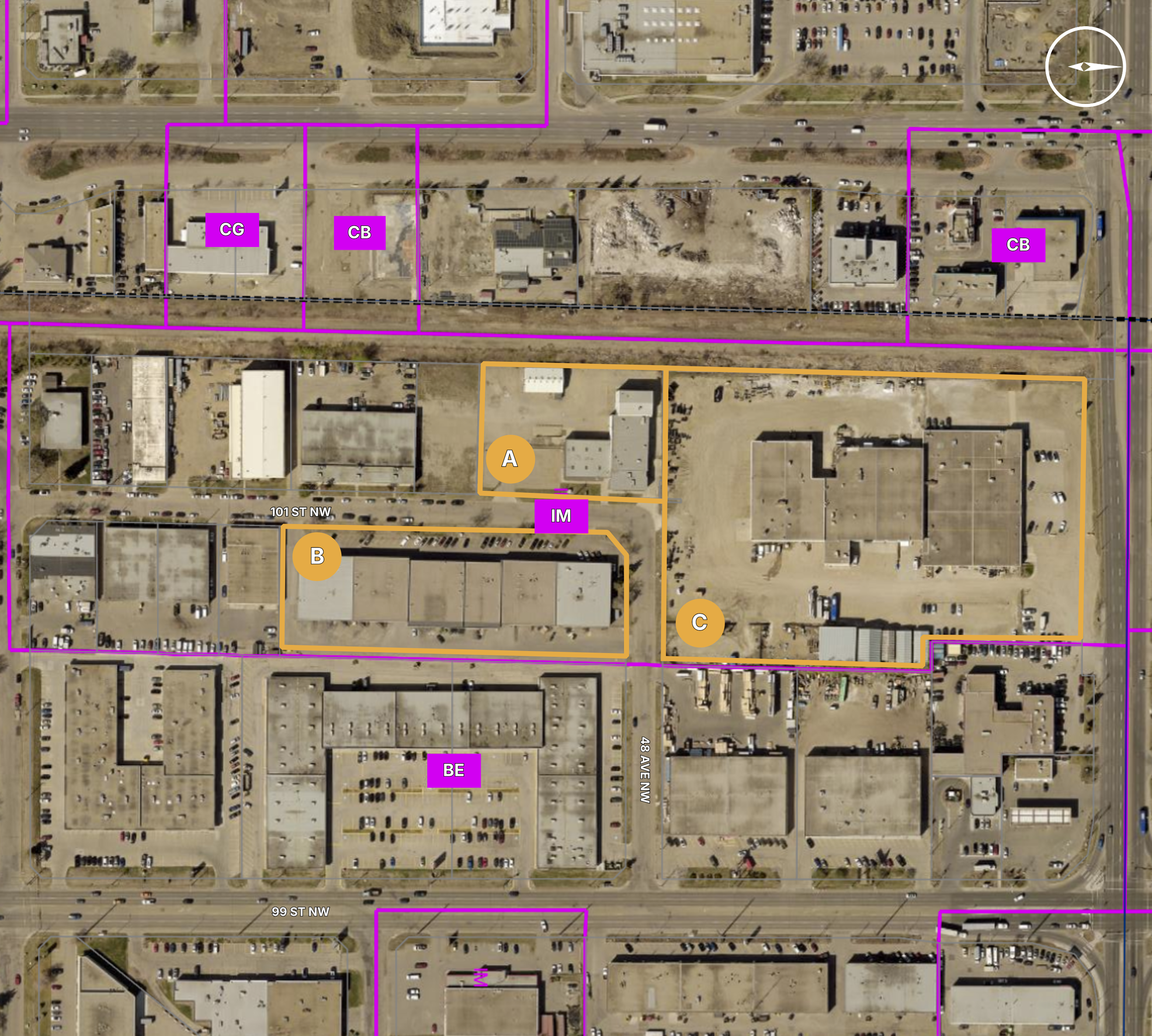
While the sites in A and C are effectively preserved for industrial use under the IIAP, buildings like the one in B are instead hindered, as IM and IH uses are not often compatible with the site’s existing built context.
Beyond the zone categories themselves, neither the IIAP nor District Policy distinguishes between levels of actual industrial activity on the ground. The narrow focus on preserving all industrial land, with little consideration for what is already present on these sites, has had a stifling effect on adaptive reuse projects in industrial areas. Unique, creative projects that are intended to reinject life into industrial areas are struggling to find policy support because they take away space for industrial uses on sites like picture B, which are not fit for industrial activities in the first place.
The cost of restricting adaptive reuse is not borne by property owners alone–the would-be tenants of these spaces are being heavily impacted as well. Older industrial land works well for community services, not-for-profits, small businesses, and recreational facilities precisely because it is more affordable. They depend on tired Class C properties in need of reinvestment, and without them, are often left with nowhere else to go.
A Case in Point
These issues with industrial regulation and policy are further demonstrated when industrial property owners attempt to resolve the zoning mismatch through the planning system. The example below is based on a recent situation. We’ve changed the location and other identifying details to keep the people involved anonymous.
In one of Edmonton's older industrial areas, an owner explored rezoning options to convert a 1970s industrial building, which sat vacant for three years, to an Indoor Recreation use. City Administration heavily discouraged the rezoning. Its IIAP Site Selector tool had marked the parcel as highly amenable to several industrial sectors. On that basis, City Administration determined the site did not qualify for conversion as it remained compatible with its industrial surroundings and practical for Medium Industrial uses.
Because the District Policy's tests that determine a site’s viability are vague, the City employs the Site Selector, an economic development and planning support tool intended to help businesses identify whether industrial sites meet their operational requirements, and to determine the development potential of the site. In theory, the Site Selector anchors each discretionary, site-specific ruling. However, the Site Selector lacks the on-the-ground, practical context of each site. It fails to factor in whether the building already on the lot can be realistically converted to industrial uses, or whether the parcel is a desirable size and shape for a new industrial development.
In this specific case mentioned above, the City concluded that the location was ideal for industrial use, which prevented rezoning. The report was based on how amenable the location is to industrial sectors–a measurement entirely unrelated to the on-the-ground contextual information required to make a decision about the site’s industrial compatibility. This locational rating does not answer pertinent questions such as whether the building already standing on the lot can practically convert to an industrial use, or if the parcel is the size and shape an investor would want for new development. In this case, and many others like it, the owner is left arguing against the Site Selector score and subsequent judgement that only speaks to the site’s location and fails to acknowledge the current, limited reality of the site.
Administration recommended the owner instead look at other land nearby that was already zoned for an Indoor Recreation use. But that land is not the owner's property, is not for sale, and land that is properly zoned for Indoor Recreation uses typically comes at a premium that the owner in question cannot carry. It is the affordability of these older industrial spaces that make them feasible for these uses.
In theory, the City supports adaptive reuse, just often not on the sites that are viable. Based on cases like the one discussed above, which have become a regular occurrence, it has become evident that the City needs to re-examine how the IIAP is being implemented.
To understand whether the IIAP is achieving its objectives, it’s worth asking: where is industrial investment actually happening? The recent sale of the 100-acre Twin Willows Golf Course to Panattoni Development illustrates the kind of investment the IIAP is built to attract.³ The site, planned for future industrial use though not yet rezoned, is slated for up to two million square feet of build-to-suit industrial space, with construction beginning as early as 2027. In an interview with the Real Estate News Exchange, Panattoni's Vice-President of Development, Mark Edwards, identified several characteristics that make the site particularly attractive for industrial development: extensive site frontage on two major arterials, a location approximately 1.5 kilometres from the Anthony Henday, a straight-line connection to the Yellowhead Trail, bus access, and close proximity to a large, easily-reachable labour pool.
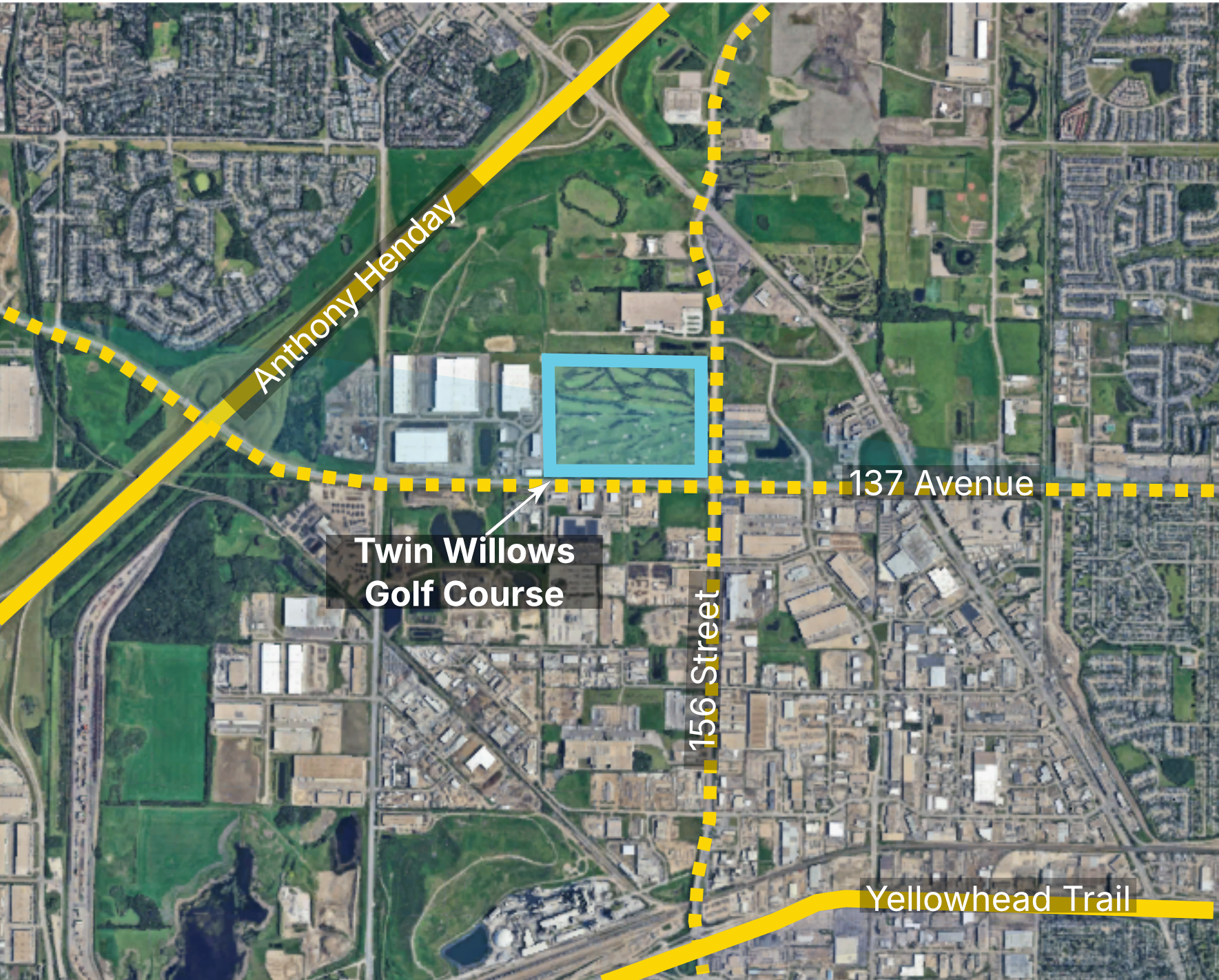
Twin Willows context map, with arterial road access highlighted.
The redevelopment of Twin Willows is not an isolated case. There are a considerable number of parcels similar to Twin Willows that present viable opportunities for industrial development. By the City's own account, as of 2023 Edmonton had more than 6,500 hectares of available industrial land and 9.95 million square feet of available industrial space marketed as development-ready.⁴ The City is also directly involved in bringing additional industrial land to market, through developments such as Goodridge Corners and Ellerslie Industrial. Whatever the precise makeup of that supply, it is difficult to reconcile a stated abundance of development-ready industrial land with a preservation policy built on protecting industrial land from being lost.
Projects like Twin Willows represent the scale of investment the City of Edmonton should be trying to recapture from neighbouring municipalities, but projects of this scope are dependent on features that many traditional industrial parcels simply cannot offer: the size, the highway access, the room to build something purpose-built for a modern operator. A two-acre lot with a 1970s building on it would never land a project like this, regardless of its zoning. The current process keeps sites like these underused. Prospective uses are turned away, leaving the property owners stuck with very limited options.
None of this is to say the City's caution around industrial land is misplaced. Each conversion of industrial-zoned property to a more creative use sets a new precedent, making the next rezoning request harder to refuse. Their incentive to maintain the industrial base by default is correct. But that caution should place the most weight on large sites that could realistically draw major industrial investment. On smaller, older sites, preservation doesn't deliver a future industrial user, it just keeps them underused.
A Better Way to Apply the Policy
The tools to resolve this mismatch already exist in Edmonton’s District Policy exemptions (Section 2.5.3). What is missing is a consistent, transparent basis for applying these exemptions. In practice, that would look like asking sharper questions than the Site Selector score does, such as: given the size and access of the building already on the site, and the conditions industrial developers are actually looking for, is major industrial development on this land realistic at all? The Site Selector score should inform a piece of that judgment, not stand in for it.
There is also a more direct fix for many of these sites. Zoning Bylaw 20001 moved away from discretionary uses to reduce uncertainty, which is a reasonable goal. But the way to alleviate uncertainty is not to remove these uses entirely; it is to permit them where they meet clear, objective criteria.
The City could amend its industrial zones to allow uses like Religious Assemblies, Indoor Recreation, or Markets as of right on sites where industrial uses are no longer practical. Eligibility could be based on objective criteria, such as buildings that cover most of their sites, physical constraints (e.g., low ceilings or poor truck access), or small and irregularly shaped parcels. This gives owners a predictable regulatory path without the planning-related hurdles that conversion would otherwise require.
Adaptive reuse of industrial spaces is not a threat to industrial supply. Uses like Markets, Religious Assemblies, and Indoor Sports do not displace new industrial development. They put underused space back to work on sites that are unlikely to support medium or heavy industrial redevelopment in the first place. Treating them as a loss of industrial land, rather than the practical outcome they are, keeps these sites in limbo.
A strong industrial tax base is key to a fiscally healthy city. But in the pursuit of this, the City has forgotten that local property owners trying to make use of their existing properties are not roadblocks to the City’s goals–they themselves are vital to a healthy city.
1 IIAP page 6
2 Policy 2.5.3.4, amended by Charter Bylaw 21164
3 John Dujay, "Panattoni buys 2M-sq.-ft. industrial site in Edmonton," Real Estate News Exchange, May 1, 2026. https://renx.ca/panattoni-buys-2m-sq-ft-industrial-site-edmonton
4 City of Edmonton, “Industrial Growth” webpage.
All photos retrieved from Google Earth (2025)